


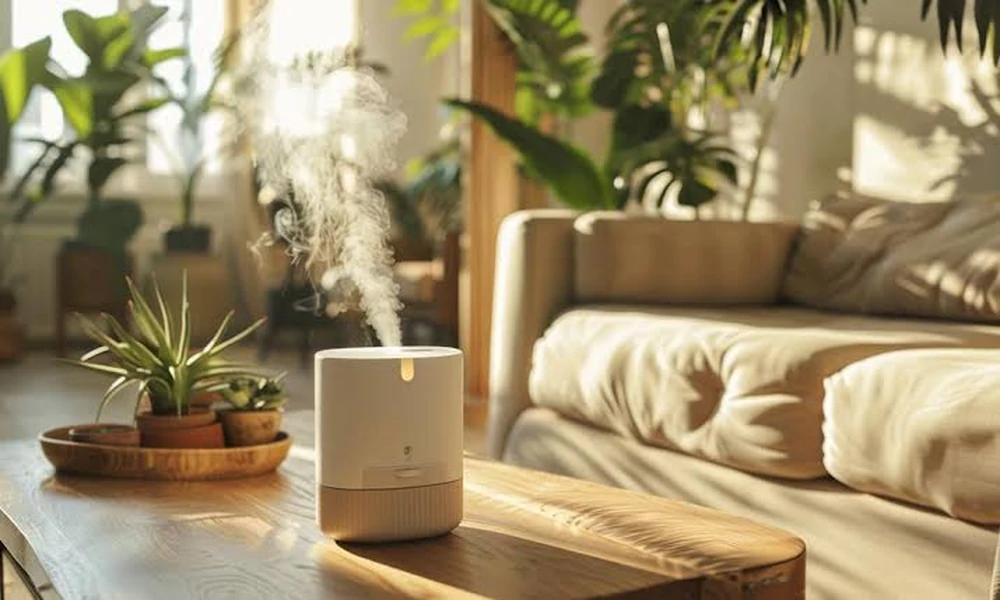
The Case Against Visible Mist in the Bedroom
Ultrasonic humidifiers produce visible mist by vibrating water at ultrasonic frequency – a technology that adds humidity effectively but carries side effects that make it less ideal for bedroom use than manufacturers typically acknowledge. The mist carries dissolved minerals from tap water into the air as a fine aerosol; those minerals settle on surfaces as a white powder that requires regular cleaning and, in sufficient concentration, can irritate airways in sensitive individuals.
The mist itself – particularly from units running at high output – creates a localized humidity spike in the area immediately surrounding the unit. If the unit is positioned near the bed, the sleeping person is exposed to locally higher humidity than the room average, which can feel uncomfortable and disrupts the evaporative cooling that contributes to the temperature regulation during sleep.
Mist-free evaporative humidifiers address both concerns by operating without producing a visible airborne mist. Water evaporates naturally from a wick into the airflow created by the unit’s fan – a process that produces no visible output, disperses no mineral aerosol, and distributes humidity more evenly through the room than a directed mist stream.
How Evaporative Technology Self-Regulates
Airdog’s mist-free bedroom humidifier uses evaporative technology that self-regulates output based on ambient humidity – a characteristic that prevents over-humidification without requiring a humidistat sensor or automatic cutoff. As room humidity rises toward the evaporative equilibrium point, the rate of evaporation from the wick naturally slows. This self-limiting behavior means the unit will not continue adding moisture beyond what the ambient conditions will hold, reducing the over-humidification risk that requires active management in ultrasonic units.
The wick is the consumable component in an evaporative humidifier – mineral deposits from tap water accumulate on the wick surface over weeks of use, reducing evaporation efficiency. Wick replacement every 1 to 3 months depending on water hardness and usage frequency is the ongoing maintenance requirement. This is a smaller cost than the filter replacement required by HEPA air purifiers, but it is a real ongoing cost to factor into the ownership calculation.
EPA Indoor Air Quality distinguishes between cool mist evaporative humidifiers and ultrasonic humidifiers in their indoor air quality guidance, noting that evaporative units do not disperse mineral dust and are less likely to disperse microorganisms if cleaning schedules slip – a practical advantage for households where maintenance consistency is variable.
Sizing and Placement for Bedroom Use
Evaporative humidifier output capacity is rated in gallons per day rather than mist output, and the appropriate capacity depends on room size and how dry the starting conditions are. A small bedroom at 30 percent relative humidity in a very dry climate requires more output capacity to reach target humidity than the same room at 40 percent in a moderately dry climate. Manufacturer coverage area ratings are a reasonable starting point, though actual performance varies with starting humidity, room leakage, and ambient temperature.
Placement in the bedroom should balance humidity distribution with practical access for refilling. A unit positioned near a wall outlet with clear floor space around it for airflow, placed 3 to 5 feet from the bed, provides good room-wide humidity distribution without directing airflow directly at the sleeping position. Units near windows lose humidity to heat loss through the glass in cold weather – placement on interior walls is more efficient.
Running the humidifier only during sleeping hours – turning it on 30 minutes before bedtime and off in the morning – is an approach that works for maintaining sleep humidity without humidifying during the day. This approach reduces wick consumption and water use compared to all-day operation while targeting the hours when humidity matters most for sleep quality.
